2026/3/26 14:31:21
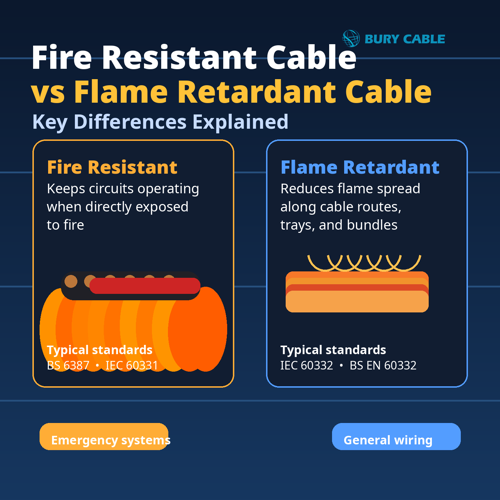
Fire Resistant Cable vs Flame Retardant Cable
Key Differences Explained
A practical guide for engineers, contractors, and buyers on when to specify cables that keep working in fire, and when cables that limit flame spread are sufficient. | |||
Topic | Key standards | For | |
When it comes to cable fire performance, many buyers, engineers, and contractors confuse fire resistant cable with flame retardant cable. Although the two terms sound similar, they refer to very different types of protection and are specified for different purposes in real projects.
Choosing the wrong type can lead to safety risk, specification errors, and unnecessary cost. In critical circuits such as fire alarms, emergency lighting, smoke extraction, and evacuation systems, understanding the difference is essential.
What is a Fire Resistant Cable? A fire resistant cable is designed to continue operating during a fire for a specified period of time. Its main purpose is to maintain circuit integrity so essential systems can keep functioning when they are needed most. Typical standards: BS 6387, IEC 60331, EN 50200 | What is a Flame Retardant Cable? A flame retardant cable is designed to reduce or delay the spread of fire along the cable route. It improves fire safety, but it is not necessarily designed to keep supplying power during direct flame exposure. Typical standards: IEC 60332, BS EN 60332, UL VW-1 |
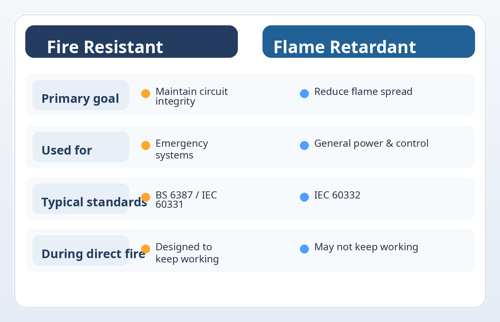
The simplest way to understand the difference is this: fire resistant cable keeps working during fire; flame retardant cable helps stop fire from spreading. A cable may limit flame spread and still fail electrically when exposed directly to fire. In emergency circuits, that distinction is critical.
Feature | Fire Resistant Cable | Flame Retardant Cable |
Main purpose | Maintain circuit integrity during fire | Limit flame spread |
Function during fire | Continues operating for a period of time | May not continue operating |
Typical standards | BS 6387, IEC 60331, EN 50200 | IEC 60332, BS EN 60332 |
Application focus | Emergency and life safety systems | General fire safety improvement |
Typical cost | Usually higher | Usually lower |
In a real fire, different systems have different performance requirements. A cable feeding decorative or non-essential circuits may only need to meet flame retardant requirements. But cables used for fire alarms, emergency lighting, smoke extraction fans, evacuation broadcast systems, firefighter lifts, and fire pumps often need to continue operating during fire.
Using a flame retardant cable alone in these emergency circuits can result in failure of essential services exactly when they are needed most.
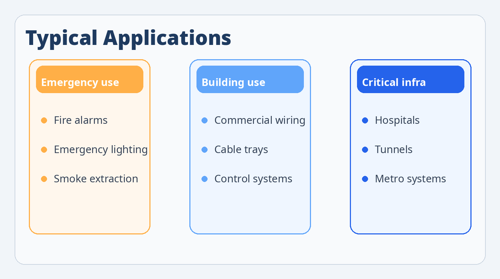
Typical Applications of Fire Resistant Cable · Fire alarm systems · Emergency lighting systems · Smoke control and smoke extraction · Voice evacuation systems · Fire pumps and firefighter communication · Hospitals, tunnels, metros, airports | Typical Applications of Flame Retardant Cable · General building wiring · Cable tray installations · Industrial power circuits · Commercial distribution systems · Control cable systems · Indoor low-voltage networks |
As a practical rule, choose fire resistant cable when the system must keep working during fire. Choose flame retardant cable when the main goal is to reduce fire spread in general wiring or power installations. Project code, installation environment, smoke and halogen requirements, and system criticality should always be reviewed together.
· Assuming all 'fire performance' cables provide the same level of protection.
· Specifying flame retardant cable in emergency circuits that require circuit integrity.
· Ignoring related requirements such as low smoke, halogen-free design, water spray, or mechanical shock.
At BURY CABLE, we support customers in selecting the right cable for both emergency systems and general fire safety applications. Whether your project requires fire resistant cable for critical circuits or flame retardant cable for standard installations, our team can provide technical guidance, product support, and responsive quotation service.
Need help choosing the right cable for your project? |
Fire resistant cable and flame retardant cable are not the same, and the difference matters. Fire resistant cable is designed to keep operating during fire, while flame retardant cable is designed to reduce the spread of flames. Understanding this distinction helps engineers, contractors, and buyers make better decisions, improve safety, and avoid costly specification errors.