2026/3/17 16:49:46
What Is BS 6387? Understanding Fire-Resistant Cable Requirements
A practical guide for engineers, buyers, and project teams selecting fire survival cables.
Fire safety cable specifications are often misunderstood during project planning and procurement. In many enquiries, the terms fire resistant and flame retardant are treated as if they mean the same thing. In practice, they solve different problems.
BS 6387 is a British Standard focused on the performance of cables required to maintain circuit integrity during fire conditions. It is commonly referenced when emergency systems must continue operating long enough to support evacuation, firefighting, and shutdown procedures.
For building services, transport infrastructure, and industrial facilities, understanding BS 6387 helps project teams choose the right cable for fire alarms, emergency lighting, smoke extraction systems, and other life safety circuits.
1. What does BS 6387 cover?
BS 6387 specifies performance requirements for cables that must continue functioning when exposed to fire. Instead of measuring only whether a cable stops flame propagation, the standard evaluates whether the cable can still maintain electrical continuity while the fire event is in progress.
The standard is especially relevant where a circuit failure would create a serious safety risk. Typical examples include emergency lighting, fire alarm systems, control circuits for smoke extraction, and firefighter support systems.
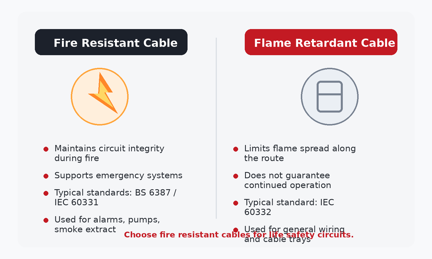
Figure 1. Fire resistant cable and flame retardant cable serve different safety functions.
2. Understanding the BS 6387 categories
BS 6387 uses three well-known test categories - C, W, and Z - to describe cable performance under specific fire-related conditions. These designations are often combined, such as CWZ, when a cable has passed multiple tests.
Category C evaluates circuit integrity under direct fire exposure. Category W adds water exposure after or during fire conditions. Category Z introduces mechanical shock while the cable remains under fire. Together, these tests simulate the kinds of stresses that may occur during real emergencies.
Category | What it indicates | Typical interpretation |
C | Circuit integrity during fire | Cable keeps working while directly exposed to flame |
W | Resistance when water is introduced | Suitable where firefighting water may affect the cable |
Z | Resistance to fire with mechanical shock | Useful where falling debris or impact is a concern |
3. Where BS 6387 cables are typically used
Cables tested to BS 6387 are commonly specified in applications where people, evacuation, or critical controls depend on continuous operation during a fire. Common examples include:
· Emergency lighting circuits
· Fire alarm and voice evacuation systems
· Smoke control and extraction fans
· Fire pumps and pressure systems
· Metro stations, tunnels, airports, and public buildings
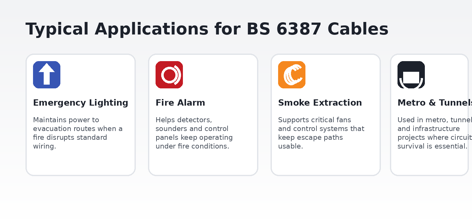
Figure 2. Representative life safety and infrastructure applications for BS 6387 cables.
4. BS 6387 vs IEC 60331 vs IEC 60332
Project teams often see BS 6387 together with IEC 60331 and IEC 60332 in datasheets and tenders. They are related, but not interchangeable.
IEC 60331 also focuses on circuit integrity during fire, while IEC 60332 is generally associated with flame propagation behaviour. A product may reference more than one standard because customers often need evidence both of fire survival and of reduced flame spread along cable routes.
When BS 6387 matters most · Life safety systems must stay operational · Specification calls for CWZ performance · Transport or public infrastructure projects · Procurement requires British Standard references | Common mistake to avoid Do not assume that a flame retardant cable automatically qualifies as a fire resistant cable. The former reduces fire spread; the latter is selected when continued electrical operation is required. |
5. How to choose the right cable for your project
When reviewing specifications, start with the function of the circuit rather than the cable price alone. Ask what must still work if a fire occurs, how long that function must be maintained, and what additional hazards may be present, such as water spray or mechanical shock.
Also confirm conductor size, voltage rating, installation environment, sheath material, and any project-specific approvals. For critical applications, the best choice is usually the cable that aligns with both the governing standard and the operating conditions of the actual site.
Need help selecting a BS 6387 cable for your project? BURY CABLE can support specification review, datasheets, and quotation requests. |
Conclusion
BS 6387 remains one of the most recognised references for fire-resistant cables used in critical circuits. Its value lies in proving whether a cable can continue working under fire-related stress conditions rather than simply resisting flame spread.
For consultants, contractors, and procurement teams, understanding the distinction helps reduce risk, improve compliance, and ensure that emergency systems perform when they are needed most.