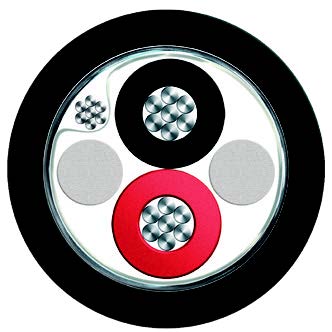
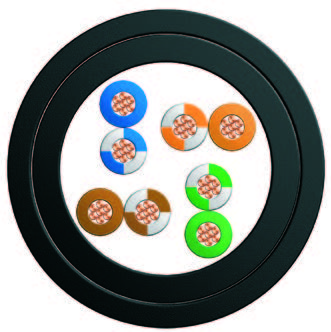
This L2 range covers two forms of moving fieldbus connection: torsional movement, including robot applications, and suspended festoon movement. The torsion construction uses a PUR sheath; the mobile-use festoon construction uses PVC. Each has its own conductor, insulation and mechanical data in the comparison tables.
| Type/Area of Application | Torsion Applications | Mobile Use |
| Cable Construction | 1x2x0.64 mm (stranded) | 1x2x0.65 mm (stranded) |
| Inner Conductor Diameter | Copper, bare (AWG 23/19) | Copper, bare (AWG 24/19) |
| Conductor Insulation | Foam-skin-PE | Cell PE |
| Conductor Colors | red, green | red, green |
| Stranding Element | 2 conductors + 2 fillers stranded together | 2 conductors + 2 fillers stranded together |
| Wrapping | Polyester foil over stranded bundle | Polyester foil over stranded bundle |
| Shielding | Polyester foil, Copper bare | Polyester foil, aluminum-lined |
| Total Shielding | Copper braid, tinned | Copper braid, tinned |
| Outer Jacket Material | PUR | PVC |
| Outer Diameter | 8.0 mm ± 0.3 mm | 8.0 mm ± 0.3 mm |
| Outer Jacket Color | Violet | Green |
| CharacteristicImpedance@3-20MHz | 150 Ω ± 10 Ω | ||||
| Conductor Resistance | 66.5 Ohm/km max. | ||||
| Insulation Resistance | 1.00 GOhm x km min. | ||||
| Mutual Capacitance@1KHz | 30.0 nF/km nom. | ||||
| Working Voltage | Max: 250 V | ||||
| Test Voltage | 1.5 KV | ||||
| Attenuation | 9.6 | kHz | < | 3.0 | dB/km |
| 38.4 | kHz | < | 5.0 | dB/km | |
| 4.0 | MHz | < | 25.0 | dB/km | |
| 16.0 | MHz | < | 51.0 | dB/km | |
| Weight | approximately 91.0 kg/km | approximately 64.0 kg/km |
| Min. Bending Radius (Laying) | 12.5 x OD mm | 5 x OD mm |
| Operating Temp.Range, min. | - 5 °C | -40 °C |
| Operating Temp.Range, max. | +60 °C | +60 °C |
Separate torsion and festoon constructions with stranded copper pairs.
PUR sheath for the torsion version and PVC sheath for the mobile-use version.
Both constructions have a listed outer diameter of 8.0 ± 0.3 mm.
Select the construction by the actual movement: twisting or suspended travel. State the movement range, bend arrangement and operating temperature with the order. Use the corresponding table column, since the two versions have different laying radii, weights and temperature limits.
Profibus L2 7-Wire Stranded Cable, 150 Ohm, PVC Sheath for Mobile Use
Profibus SK FRNC and Industry Cable, 150 Ohm, FRNC or PUR Sheath
The torsion construction has a PUR sheath. The mobile-use festoon construction has a PVC sheath.
The torsion version uses foam-skin PE; the festoon version uses cellular PE.
The tables list 12.5 times the overall diameter for the torsion version and 5 times for the mobile-use version.
The torsion column gives −5°C to +60°C; the mobile-use column gives −40°C to +60°C.
Identify the construction and describe the equipment movement, available bending space, cable length and termination arrangement.