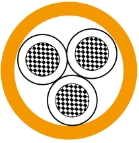
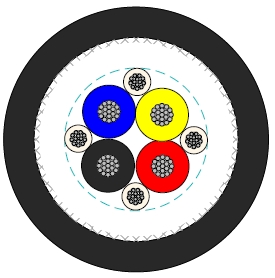
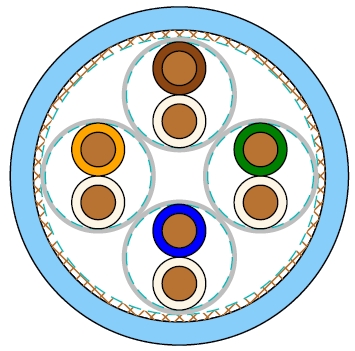
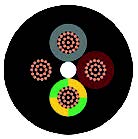
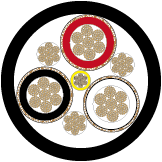
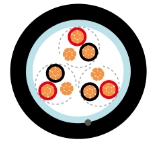
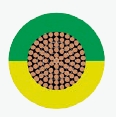
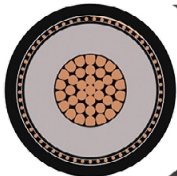
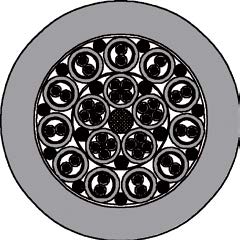
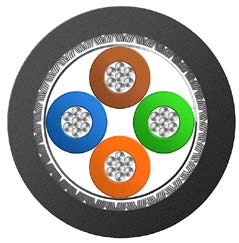
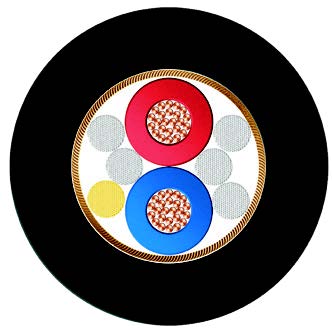
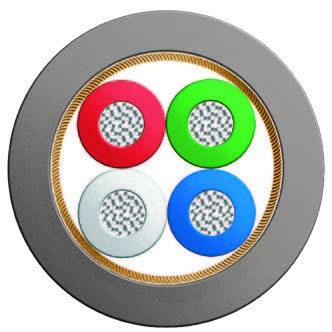
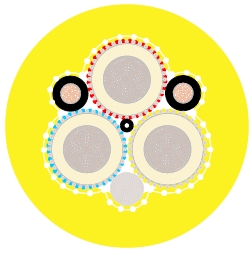
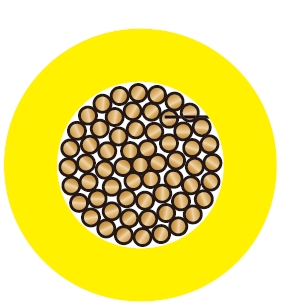
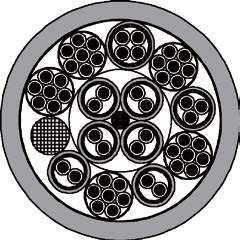
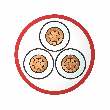
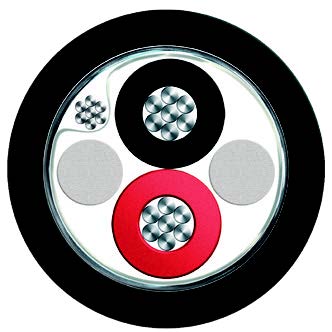
G7621 A2 communication cables are intended for fixed trackside bracket runs. Type 1 uses a PVC sheath for open locations, while Type 2 uses an LSZH sheath for tunnel or underground installations. Solid plain copper conductors with cellular PE insulation are twisted into pairs and wrapped in non-hygroscopic tape. The dimensions table lists one-pair and three-pair Type 1 constructions.
LUL Spec G7621 A2 type 1 (for PVC sheath)
LUL Spec G7621 A2 type 2 (for LSZH sheath)
Core IdentificationConductoBR: Solid plain copper, 0.63/0.9 mm nominal diameter.
Insulation: Cellular polyethylene.
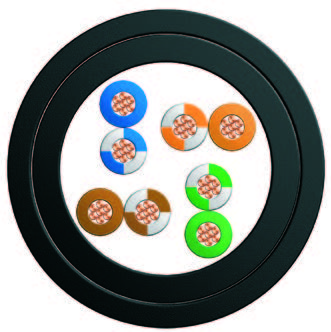
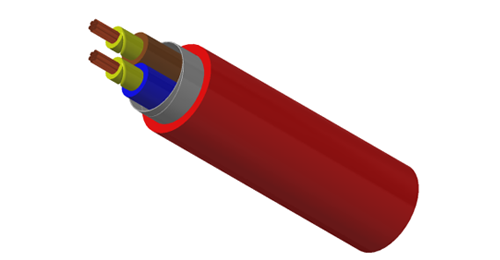
Cabling Element: Two insulated conductoBR are twisted together to form a pair.
Core Wrapping: Non-hygroscopic plastic tape with overlapping.
Outer Sheath: PVC/LSZH sheath, coloured violet.
1 Pair Cable: Blue / White
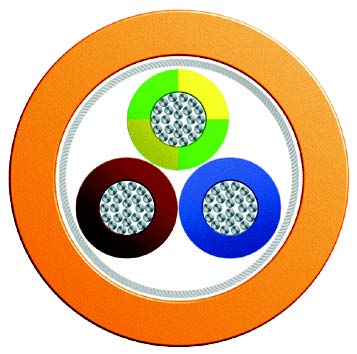
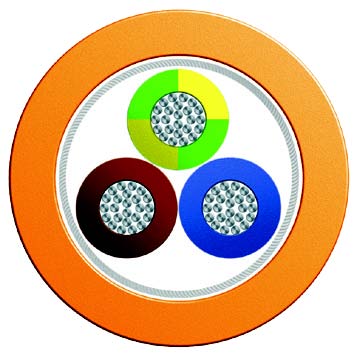
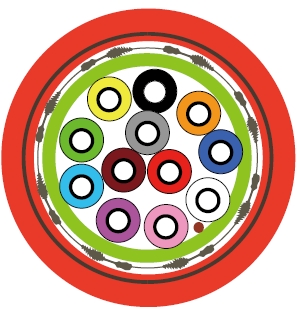
3 Pair Cable: Blue / White; Orange / White; Green / White
| Nominal Conductor Diameter | mm | 0.63 | 0.9 |
| Maximum Conductor Resistance | |||
| Average Value | Ω/km | 57.5 | 28 |
| Individual Value | Ω/km | 59 | 29 |
| Minimum Insulation Resistance @500 V DC | MΩ.km | 1500 | 1500 |
| Maximum Average Mutual Capacitance | nF/km | 59 | 59 |
| Maximum Average Capacitance Unbalance | |||
| Pair to Pair | pF/460m | 100 | 100 |
| Pair to Earth | pF/460m | 1200 | 1200 |
Minimum Bending Radius: 7.5×OD
Temperature Range: -30℃ to +70℃ (during operation); -10℃ +55℃ (during installation)
| Cable Code | No. of paiBR | Nominal Thickness of Sheath mm | Nominal Overall Diameter mm | Nominal Weight kg/km |
|---|---|---|---|---|
| 0.63mm Conductor, 1.15mm Insulated Wire | ||||
| BR7621A2/T1-02YY-1P0.63 | 1 | 2.5 | 7.0 | 60 |
| BR7621A2/T1-02YY-3P0.63 | 3 | 2.5 | 9.0 | 90 |
| 0.9mm Conductor, 1.5mm Insulated Wire | ||||
| BR7621A2/T1-02YY-1P0.9 | 1 | 2.5 | 8.0 | 70 |
| BR7621A2/T1-02YY-3P0.9 | 3 | 2.5 | 10.0 | 120 |
Solid copper conductors in 0.63 mm and 0.9 mm nominal diameters.
Cellular PE insulation and a violet PVC or LSZH sheath.
Separate Type 1 and Type 2 references under LUL Spec G7621 A2.
Select the sheath type for the installation location, then specify conductor diameter and pair count. The four dimension rows identify Type 1 cable codes; specify the Type 2 construction explicitly for an LSZH requirement. Distinguish the installation temperature range from the wider service range when planning cable laying.
How do Type 1 and Type 2 differ?
Type 1 has a PVC sheath for open locations. Type 2 uses an LSZH sheath for tunnels and underground locations.
Which conductor sizes are listed?
Nominal conductor diameters of 0.63 mm and 0.9 mm. These figures describe diameter rather than cross-sectional area.
Which pair counts appear in the dimensions table?
One-pair and three-pair Type 1 cables, each listed for both conductor diameters.
What colours identify the three pairs?
Blue/white, orange/white and green/white.
What temperature limits apply during installation?
The listed installation range is −10°C to +55°C; the operating range is −30°C to +70°C.