Metro and tunnel systems are among the most fire-sensitive infrastructures in the world.
Once a fire occurs in an underground environment, evacuation difficulty, toxic smoke, and loss of visibility can quickly turn a minor incident into a major disaster.
For this reason, cables used in metro and tunnel projects must continue to operate during fire conditions, especially for:
Emergency lighting
Fire alarm systems
Ventilation and smoke extraction
Communication and control systems
Standard flame-retardant cables are not sufficient for these applications.
Cables used in metro and tunnel environments must meet several critical performance requirements:
Cables must continue transmitting power or signals for a specified duration under direct flame exposure.
Dense smoke and toxic gases are the primary cause of casualties during underground fires.
Cables must maintain performance even under mechanical impact and water spray during firefighting.
Metro infrastructure is designed for decades of service life with minimal maintenance.
BS 6387 is one of the most widely accepted fire-resistant cable standards for critical infrastructure projects.
C – Fire resistance at 950°C
W – Fire resistance with water spray
Z – Fire resistance with mechanical shock
A BS 6387 CWZ cable is tested to operate under simultaneous fire, water, and mechanical impact, making it ideal for metro and tunnel applications.
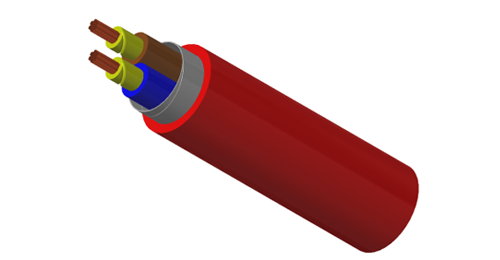
Typical fire resistant cable design includes:
Conductor: Annealed copper (solid or stranded)
Insulation: Mica tape + XLPE
Inner Sheath: LSZH compound
Armour (optional): Steel wire armour for mechanical protection
Outer Sheath: LSZH, low smoke, halogen-free
This structure ensures both electrical continuity and fire survival performance.
Fire resistant cables are commonly used in:
Emergency lighting circuits
Fire detection and alarm systems
Tunnel ventilation and smoke extraction
Public address and communication systems
Power supply for safety-critical equipment
In most projects, these cables are mandatory, not optional.
Proper installation is just as important as cable selection:
Avoid sharp bending radii
Use fire-rated cable supports and cleats
Ensure compatibility with fire-stopping systems
Follow project-specified routing and segregation rules
Incorrect installation can compromise even the highest-grade fire resistant cables.
When sourcing fire resistant cables for metro or tunnel projects, buyers should evaluate suppliers based on:
Valid BS 6387 CWZ test reports
Factory manufacturing capability (not trading only)
Experience in infrastructure projects
Ability to customize cable structure
Stable lead time and batch consistency
Choosing the wrong supplier can create serious compliance and safety risks.
| Item | Description |
|---|---|
| Industry | Metro & Tunnel Infrastructure |
| Key Systems | Emergency lighting, alarms, ventilation |
| Recommended Standard | BS 6387 CWZ |
| Cable Type | Fire Resistant LSZH Cables |
| Service Life | Long-term infrastructure use |
Q1: Are BS 6387 CWZ cables mandatory for all metro projects?
Most modern metro and tunnel specifications require fire resistant cables meeting BS 6387 or equivalent standards for safety-critical systems.
Q2: Can cable structure be customized?
Yes. Conductor size, armour, sheath material and voltage rating can be customized according to project requirements.
Q3: What is the typical lead time?
Lead time depends on cable type and quantity. Factory-direct suppliers can usually offer more stable delivery schedules.
Q4: Are test certificates provided?
Reputable manufacturers provide full BS 6387 CWZ test reports and quality documentation.
If you are working on a metro or tunnel project and need reliable fire resistant cable solutions:
Contact us to request technical specifications, test reports, and project-based quotations.
We supply fire resistant cables for infrastructure projects in Europe, the Middle East, and Southeast Asia, supporting both standard and custom requirements.
Working on a metro or tunnel project?
We provide BS 6387 CWZ fire resistant cables designed for emergency lighting, alarms and ventilation systems.View product specifications →