A cable test report is useful only when it can be matched to the cable delivered. For an EPC package, inspection starts with the approved construction and ends with a documented release of identified drums. Engineering, procurement and quality teams need an agreed test scope before manufacture, with clear acceptance criteria and records that remain usable at site.
Record the cable designation, rated voltage U₀/U (Uₘ), conductor size and class, insulation, metallic layers and sheath. Specify the contractual standard and edition. IEC 60502-1:2021 covers extruded-insulation cables rated 1 kV and 3 kV; IEC 60502-2:2014 + AMD1:2024 covers 6–30 kV cables. The latter consolidated publication includes a July 2026 corrigendum. Apply the edition adopted by the project.
Agree the inspection and test plan (ITP), document submissions, sampling basis and witness arrangements before releasing production. The tables below are an EPC review framework. The applicable product standard and approved project specification determine the actual tests and limits.
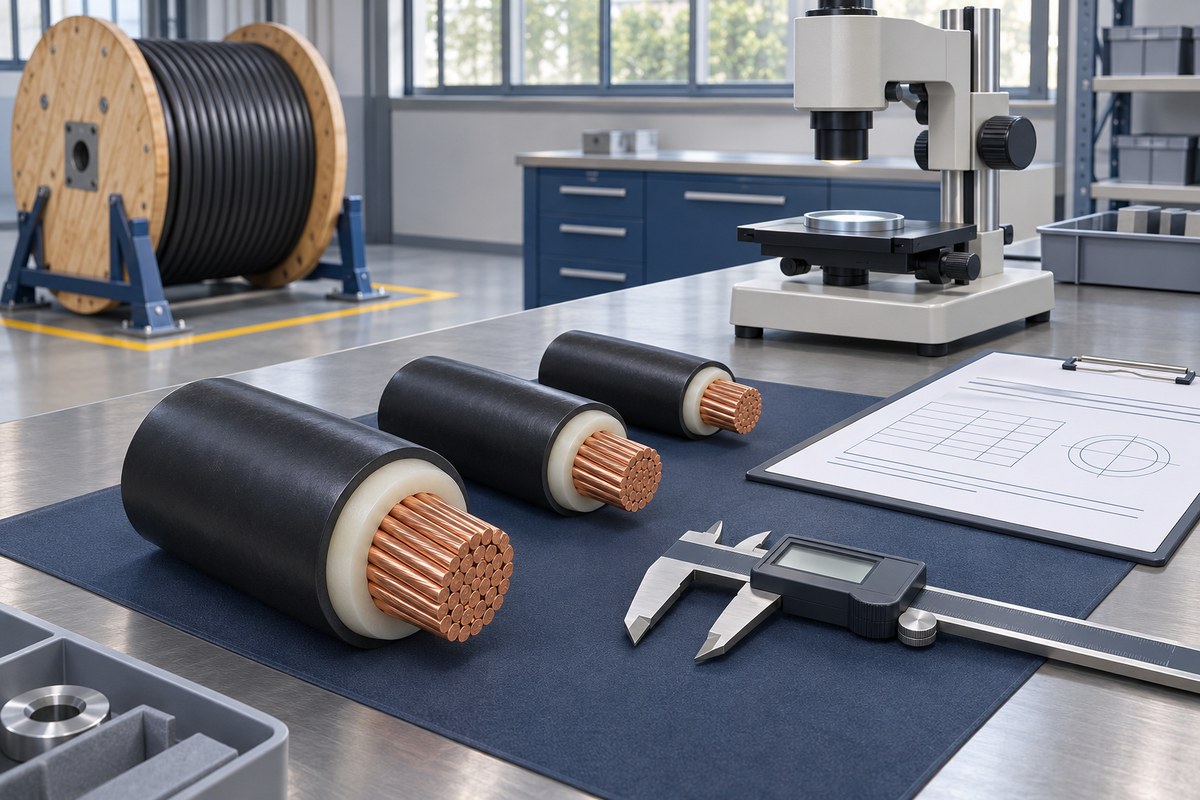
Dimensional inspection supports construction verification. Illustration.
| Test category | Purpose and coverage | What the buyer should check |
|---|---|---|
| Routine | Checks production conformity, normally on each manufactured length under IEC 60502. | Trace results to the supplied lengths; identify any permitted, agreed reduction in testing. |
| Sample | Checks selected finished cable or components at the specified frequency. | Confirm selection, batch coverage and the required sampling procedure. |
| Type | Demonstrates the performance of a cable design before general commercial supply. | Confirm the report covers the offered design and materials; assess changes that could affect performance. |
A type-test report does not identify the results for every delivered drum. Review its tested construction and scope alongside the production records. A change in materials, design or manufacturing process may require renewed type testing when it could alter performance.
| Check | LV cable package | Screened MV cable package |
|---|---|---|
| Conductor resistance | Routine test under IEC 60502-1. | Routine test under IEC 60502-2. |
| Voltage withstand | Use the applicable routine test method and acceptance criteria. | Use the specified MV method, voltage and duration. |
| Partial discharge | Not a routine requirement of IEC 60502-1. | Required for screened cables within the applicable IEC 60502-2 scope. |
| Construction and dimensions | Verify conductor, insulation, sheath and armour where fitted. | Also verify insulation screens and metallic screen construction. |
| Material properties | Select checks for the actual compounds; hot-set testing applies to specified cross-linked materials. | Match the insulation and sheath compounds to the applicable test schedule. |
| Oversheath integrity | Agree any required electrical sheath test for the construction. | Check applicability of the routine oversheath test and later site checks. |
For conductor resistance, review the temperature correction to 20°C and the reported Ω/km value against the limit for the conductor material, class and size. For dimensions, distinguish nominal values from minimum or mean acceptance limits. A single overall-diameter measurement cannot establish insulation thickness.
Partial-discharge testing evaluates discharge activity at defined test conditions. Its voltage and sensitivity must follow the relevant cable standard. Insulation-resistance measurements serve a different purpose and should not be used as a substitute for voltage withstand or required partial-discharge tests.
A factory acceptance test (FAT) is a contractual inspection event. It may include witnessed tests, review of existing results and examination of finished drums. State which activities are hold points, which require notice for witnessing, and who can authorize progression. Define what happens if a witness cannot attend.
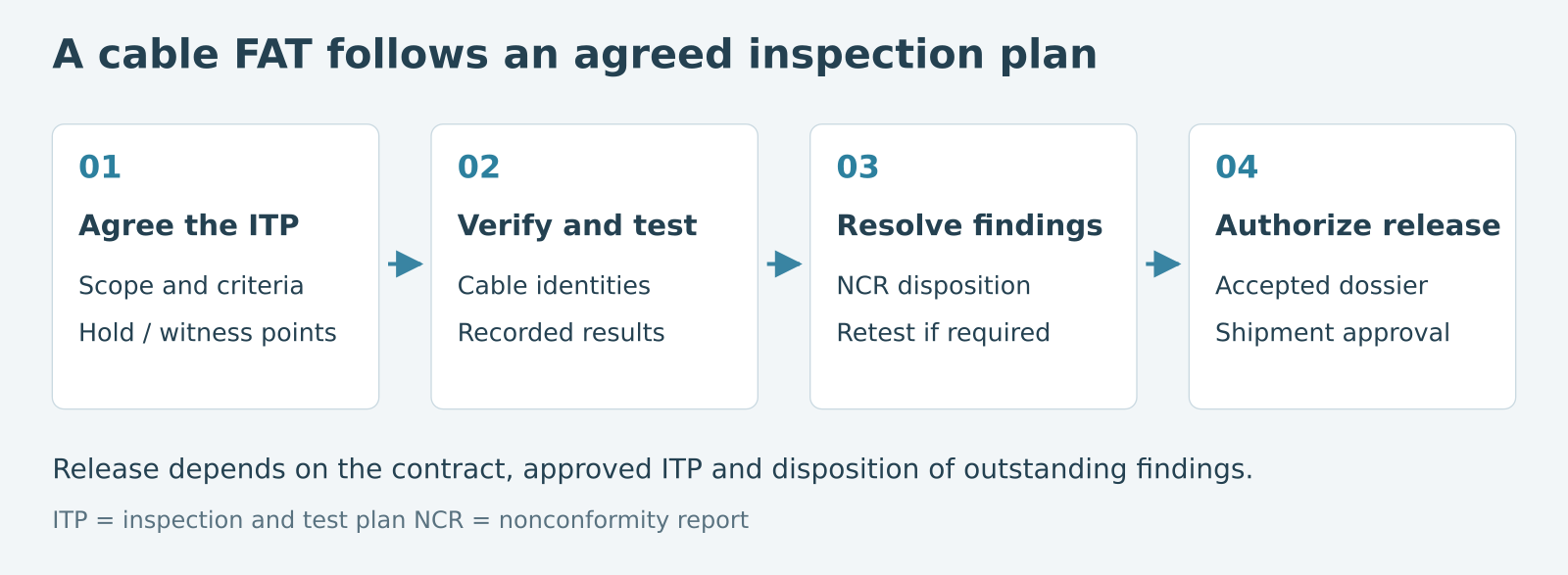
Agree the release conditions before the inspection date.
| ITP item | Evidence to prepare | Acceptance question |
|---|---|---|
| Scope and revision | Approved datasheet, order line, deviations and applicable clauses. | Is the inspected cable the approved construction? |
| Test coverage | Manufactured lengths, selected samples and applicable type-test reports. | Does the evidence cover this order and design? |
| Measurements | Method, conditions, instrument ID, calibration status, result and limit. | Can the reviewer determine compliance from the record? |
| Drums and packing | Drum schedule, marking, length and end-seal inspection. | Do physical identities match the documents? |
| Release | Signed inspection record, resolved blocking findings and authorized concessions. | Are all contractual release conditions satisfied? |
Example: the packing list identifies drum D017, but the test report carries only a production-length number. Request the controlled record linking that number to D017 before accepting the dossier. If the measured result itself fails, identify and segregate the affected material, raise a nonconformity report and follow the applicable investigation and retest rules. Preserve the original failed result and the approved disposition.
Use a cable and drum register as the link between procurement and site receiving. Where a manufactured length is split or rewound, preserve the relationship between the original test record and each delivery drum. Record cut lengths and remaining lengths as installation progresses.
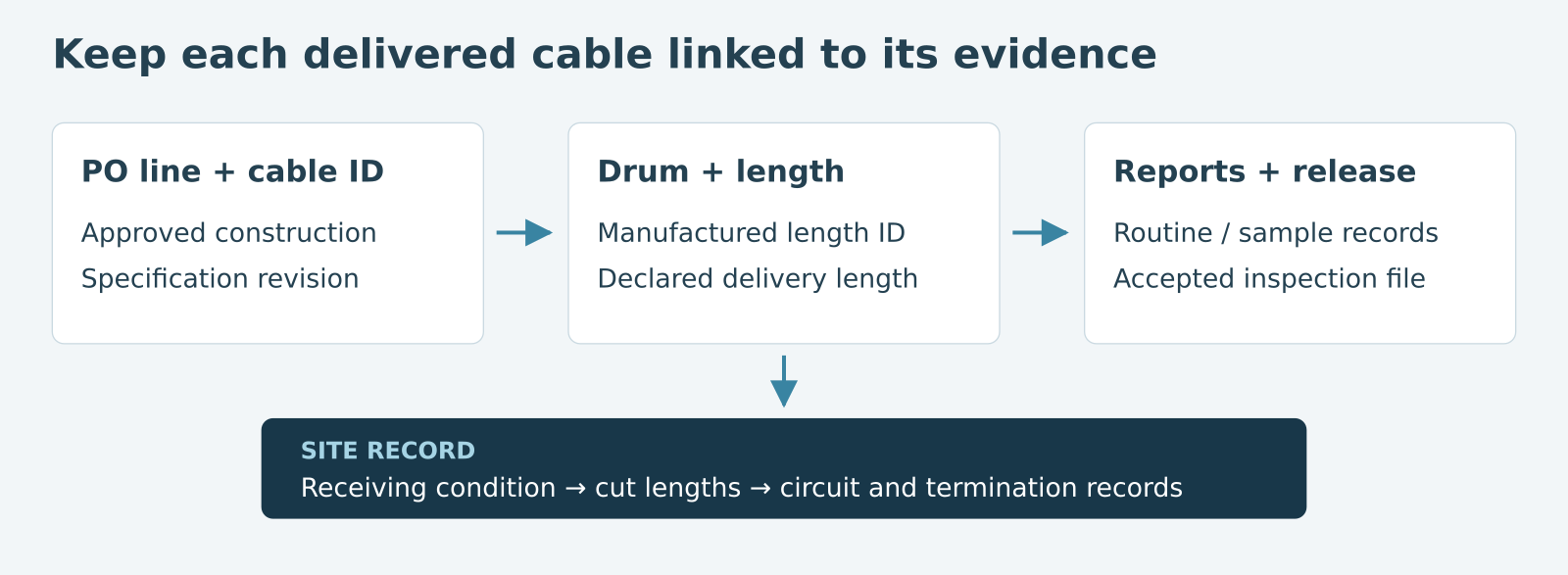
A controlled identity link makes factory evidence usable during installation and handover.
| Before shipment or at receiving | Record to retain |
|---|---|
| Cable identity | PO line, cable ID, full designation, voltage, size and approved revision. |
| Drum identity and length | Unique drum number, declared length and link to the tested manufactured length. |
| Marking and physical condition | Readable marking; sheath, drum and end-seal condition; photographs of damage. |
| Test dossier | Applicable routine and sample results, accepted type-test evidence and inspection release. |
| Exceptions | Open items, restrictions, approved concessions and responsible close-out parties. |
Transport, pulling, jointing and termination introduce conditions that factory tests cannot assess. Inspect deliveries before storage and record damage against the drum identity. Complete the specified inspections and tests after installation using a procedure suited to the cable, accessories and adopted installation rules. Qualified personnel should select and apply the approved test method; factory test settings are not universal commissioning settings.
For the wider purchasing and installation sequence, see our EPC cable procurement and electrical installation guide.
Type tests establish design performance. Delivery acceptance needs applicable type-test evidence plus production records traceable to the supplied cable. Confirm the required report format and traceability before ordering.
Use a common ITP format, then adapt its tests to the voltage rating, screened or unscreened construction, compounds and contractual standard. Fire, smoke and gas-emission requirements also need their own specified tests and acceptance criteria.
Provide the cable schedule, construction and voltage requirements, standards, required test evidence, witnessing arrangements, drum lengths and delivery dates. List deviations that need approval before production.
Review our 0.6/1 kV XLPE insulated armoured cable and IEC 60502-2 MV XLPE cable alongside your project specification. Product pages support initial selection; agree the final construction and inspection scope in the order documents. Send BURY CABLE your cable schedule and ITP requirements for technical review and quotation.
IEC 60502-1:2021; IEC 60502-2:2014 + AMD1:2024, corrected July 2026;