SCADA systems are widely used in industrial automation, power utilities, water treatment plants, oil and gas facilities, transportation systems and infrastructure projects. In these systems, cables are not only used to transmit signals. They also support stable communication between field devices, control panels, PLCs, RTUs and central monitoring systems.
Choosing the right SCADA cable is important for signal stability, system reliability and long-term project performance. A cable that looks acceptable on paper may still cause communication problems if shielding, sheath material, installation environment or electrical parameters are not properly considered.
This article explains the key points that engineers, contractors and purchasing teams should confirm when selecting SCADA cables for industrial and infrastructure projects.
For related background, readers may also refer to BURY CABLE’s existing page: Choosing the Right SCADA Cable: A Comprehensive Guide.
SCADA stands for Supervisory Control and Data Acquisition. A SCADA cable is normally used for data communication, signal transmission and control system connection in automation networks.
Depending on the project design, SCADA cable may refer to a twisted pair data cable, an instrumentation cable, a screened control cable or a special communication cable designed for a specific protocol. This is why the project specification should always be checked carefully before quotation or procurement.
Application | Typical Cable Direction |
PLC / RTU communication | RS485, RS422, Modbus or other industrial communication cable |
Instrumentation signal | Screened instrumentation cable, often multipair or multicore |
Control panel wiring | Screened or unscreened control cable depending on noise level |
Outdoor utility network | UV-resistant and moisture-resistant sheath, sometimes armour |
Public building or tunnel | LSZH sheath and project-specified fire performance |
Before choosing a SCADA cable, the following information should be confirmed. A simple description such as “SCADA cable” is usually not enough for accurate quotation.
· Cable application and system type
· Communication protocol, such as RS485, Modbus, PROFIBUS, CAN Bus or project-specific protocol
· Number of pairs or cores
· Conductor size and conductor material
· Shielding structure: pair screen, overall screen, braid screen or combined screen
· Armour requirement, such as SWA, STA or unarmoured construction
· Sheath material: PVC, PE, LSZH or special compound
· Indoor, outdoor, direct buried, tray, duct or conduit installation
· Fire performance, UV resistance, oil resistance or chemical resistance requirements
· Applicable standard, project specification and destination market requirements
· Quantity, drum length, delivery time and destination port
A clearer enquiry example would be:
BS EN 50288-7 instrumentation cable, 2 pairs x 1.5mm², individual and overall screen, SWA armour, LSZH outer sheath, 0.6/1kV, 5,000 meters.
3. Cable Structure: Screen, Pair, Armour and Sheath
The structure of a SCADA cable should match the electrical environment and mechanical risk of the project. In industrial sites, the cable may be routed near motors, variable frequency drives, power cables, switchgear or substations. In this case, shielding and grounding design become critical.
SCADA and industrial communication systems are often installed near equipment that can generate electromagnetic interference. For this reason, shielding is one of the most important parts of SCADA cable design.
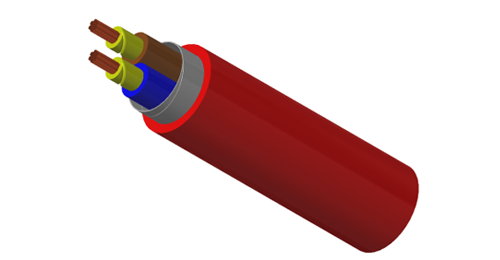
Common shielding structures include aluminium/polyester tape screen, tinned copper drain wire, copper wire braid, individual pair screen, overall screen, or individual and overall screen. For normal industrial communication, an overall screen may be sufficient. For sensitive signals or complex industrial environments, individually screened pairs plus an overall screen may be required.
If the cable is used near medium voltage cables, variable frequency drives, heavy machinery or substations, a higher level of screening should be considered.
Environment | Recommended Signal Protection | Mechanical Protection |
Low-noise indoor control room | Overall screen or standard screened control cable | Usually unarmoured |
Industrial plant with motors or VFDs | Individual pair screen + overall screen preferred | Armour if mechanical risk exists |
Outdoor utility or water project | Overall screen, PE or UV-resistant sheath | Armour often required |
Direct buried installation | Screen according to signal sensitivity | SWA / STA commonly considered |
Tunnel, station or public building | Screened LSZH cable | Armour depends on route and project spec |
Many SCADA communication cables use twisted pair construction. Twisting helps reduce electromagnetic interference and improves signal balance.
For RS485 or Modbus communication, twisted pair cable is commonly used because it supports differential signal transmission. In long-distance communication, cable capacitance, impedance and shielding performance can affect signal quality.
When selecting cable for communication networks, it is useful to confirm pair structure, characteristic impedance, mutual capacitance, conductor resistance, screen coverage, maximum transmission distance, communication speed and grounding method.
For product cross-linking, this section can link to BURY CABLE’s WTB / MVB railway communication cable page where relevant to industrial communication and rolling stock cable categories.
Armour is not always required, but it is often specified in industrial and infrastructure projects. Armoured SCADA cable may be selected when the cable is installed underground, direct buried, in outdoor trenches, in industrial plants, in areas with mechanical risk, or in utility networks.
For multicore and multipair cables, steel wire armour is commonly used where strong mechanical protection is required. If the cable is installed in cable trays or conduits with low mechanical risk, an unarmoured screened cable may be enough.
The outer sheath material should be selected according to the installation environment and project safety requirement.
PVC sheath is commonly used for general industrial applications. PE sheath is often used for outdoor, underground or moisture-sensitive environments because it provides good water resistance and mechanical performance. LSZH sheath is preferred for public buildings, tunnels, transport systems, data centres, control rooms and enclosed areas where low smoke and low halogen emission are required during fire.
For outdoor projects, it is important to confirm whether the sheath needs to be UV resistant. For oil and gas, petrochemical or industrial sites, oil resistance, chemical resistance or hydrocarbon resistance may also be required.
Sheath | Typical Use | Main Advantage | Selection Note |
PVC | General industrial installations | Economical and widely used | Not ideal where low smoke and low halogen are required |
PE | Outdoor, underground, wet or utility applications | Good moisture resistance and outdoor performance | Fire performance should be checked separately |
LSZH | Buildings, tunnels, transport, data centres and control rooms | Low smoke and low halogen emission during fire | Usually higher cost than PVC |
Special compound | Oil & gas, chemical plant, mining or special industrial projects | Can meet oil, UV, hydrocarbon or chemical resistance needs | Must be confirmed against project specification |
Related product links can be added to the sheath and control cable sections, such as H05VV5-F control cable and H07RN-F rubber flexible cable where suitable for product navigation.
SCADA cables may be installed in control rooms, substations, tunnels, buildings and other safety-critical areas. In these cases, fire performance should be checked carefully.
Common requirements may include flame retardant performance, LSZH sheath, reduced corrosive gas emission, fire resistant performance for emergency systems and CPR classification for European building projects.
Not every SCADA cable needs to be fire resistant. However, if the cable is used for emergency control, alarm systems, fire detection, evacuation systems or life safety systems, a higher fire performance level may be required. The project specification should always be used as the final reference.
Internal technical cross-links can include BURY CABLE’s existing fire-related technical pages, for example IEC 60332 Fire Test Explained and the relevant BS 6387 fire-resistant cable articles when the article discusses fire safety.
Depending on the project location and consultant specification, SCADA cables may be designed according to different standards. For European and international projects, instrumentation and control cable specifications are often more important than a simple cable name.
Commonly requested standards or specification directions include BS EN 50288-7, IEC 60092 series for marine and offshore projects, IEC 60502 where power-related cable design is involved, VDE standards for European projects, and project-specific oil and gas cable specifications.
For European projects, BS EN 50288-7 is frequently used for instrumentation and control cables. For industrial automation and data communication, the project documents may also specify electrical performance requirements such as impedance, capacitance and screening.
Recommended product cross-link: RE-2Y(St)YSWAY-TIMF instrumentation cable to BS EN 50288-7.
To provide an accurate quotation for SCADA cable, the following information is recommended:
· Cable standard or project specification
· Communication protocol
· Number of pairs or cores
· Conductor size
· Shielding requirement
· Armour requirement
· Sheath material
· Voltage rating
· Installation method
· Indoor or outdoor application
· Fire performance requirement
· Quantity
· Required delivery time
· Destination country or port
If the buyer has a cable schedule, datasheet or BOQ, it is best to send the complete document for technical review.
BURY CABLE supplies industrial, instrumentation, control and communication cables for automation, utility, infrastructure and industrial projects.
The cable range includes screened instrumentation cables, RS485 communication cables, armoured control cables, LSZH cables, fire resistant cables, British Standard cables and IEC standard power cables.
For SCADA cable projects, the BURY CABLE team can help review the project specification, confirm the cable structure and provide a suitable quotation based on the required standard, installation environment and application.
For enquiry conversion, add a contact link at the end: Contact BURY CABLE.
SCADA cable selection should not be based only on the cable name. The actual structure, shielding, sheath material, armour, installation environment and fire performance requirements all need to be confirmed.
For industrial and infrastructure projects, choosing the right SCADA cable can help improve communication stability, reduce interference risk and support long-term system reliability.
If you are working on a SCADA, automation, utility or infrastructure project, send your cable schedule or technical specification to BURY CABLE. Our team will help you confirm the suitable cable design and quotation.
Email: [email protected]
Website: www.burycable.com