Hospitals operate 24 hours a day and accommodate patients who may not be able to evacuate quickly in emergency situations.
In the event of a fire, maintaining power and signal transmission to critical systems is essential to protect lives.
Unlike commercial buildings, hospitals rely heavily on uninterrupted electrical systems to support:
Emergency lighting for evacuation routes
Fire alarm and detection systems
Life-support and monitoring equipment
Communication systems for staff coordination
For these reasons, hospitals require fire resistant cables, not standard flame-retardant solutions.
Fire resistant cables are commonly specified in hospitals for the following systems:
Emergency lighting and exit signage
Fire alarm and detection systems
Nurse call and communication systems
Critical power supply circuits
Smoke control and ventilation systems
Failure of any of these systems during a fire can significantly increase risks to patients and medical staff.
Fire safety standards often distinguish between fire resistant and flame retardant cables, but these two are frequently misunderstood.
| Feature | Fire Resistant Cables | Flame Retardant Cables |
|---|---|---|
| Maintain circuit integrity during fire | ✔ | ✖ |
| Continue power/signal transmission | ✔ | ✖ |
| Designed for life safety systems | ✔ | Limited |
| Typical hospital application | Emergency systems | General wiring |
Flame retardant cables are designed to slow down flame spread, while fire resistant cables are designed to keep systems operating during fire conditions.
For hospital emergency systems, fire resistant cables are usually required.
BS 6387 is a widely recognized standard for fire resistant cables used in safety-critical applications.
The CWZ classification includes three performance tests:
C – Resistance to fire at 950°C
W – Resistance to fire with water spray
Z – Resistance to fire with mechanical shock
Hospital environments often involve sprinkler systems, water spray from firefighting, and mechanical impact during evacuation.
BS 6387 CWZ cables are designed to maintain circuit integrity under these combined conditions.
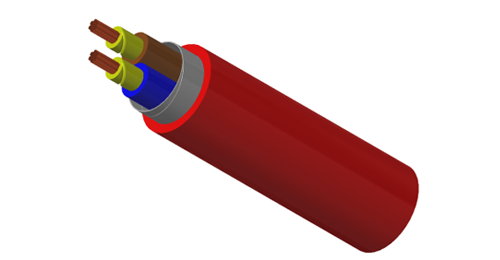
Fire resistant cables used in hospitals typically feature the following construction:
Conductor: Annealed copper
Insulation: Mica tape combined with XLPE
Inner Sheath: Low Smoke Zero Halogen (LSZH) compound
Armour (optional): Steel wire armour for added protection
Outer Sheath: LSZH for low smoke and low toxicity
This structure helps ensure electrical continuity while minimizing smoke and toxic gas emission.
Proper installation is essential to achieve the intended fire performance of cables:
Use fire-rated cable supports and fixings
Maintain appropriate bending radius to avoid insulation damage
Ensure compatibility with fire-stopping systems
Separate emergency circuits from non-critical wiring
Installation quality plays a critical role in the overall safety of hospital electrical systems.
When selecting fire resistant cables for healthcare facilities, project teams should consider:
Compliance with BS 6387 CWZ or equivalent standards
Availability of valid test reports and certifications
Long-term reliability and service life
Ability to customize cable specifications
Supplier experience in healthcare or infrastructure projects
Choosing the right cable supplier helps reduce project risk and ensures regulatory compliance.
| Item | Description |
|---|---|
| Industry | Hospital / Healthcare |
| Key Systems | Emergency & Life Safety Systems |
| Recommended Standard | BS 6387 CWZ |
| Cable Type | Fire Resistant LSZH Cables |
| Typical Service Life | Long-term infrastructure use |
Q1: Are fire resistant cables mandatory in hospitals?
Most modern hospital projects require fire resistant cables for emergency and life safety systems to comply with fire safety regulations.
Q2: Can fire resistant cables be customized for hospital projects?
Yes. Conductor size, sheath material, armour type and voltage rating can be customized based on project requirements.
Q3: Are BS 6387 CWZ test reports available?
Reputable manufacturers provide full test reports and quality documentation upon request.
If you are sourcing fire resistant cables for a hospital or healthcare project, reliable performance during fire conditions is essential.
We supply BS 6387 CWZ fire resistant cables designed for emergency lighting, fire alarm and critical power systems in hospitals, supporting long-term safety and compliance.
→ Request Technical Datasheet & Quotation
We supply fire resistant cable solutions to projects in Europe, the Middle East and Southeast Asia, supporting both standard and customized requirements.
Fire resistant cables are widely used in critical infrastructure projects, such as metro and tunnel systems, where maintaining circuit integrity during fire conditions is essential.
For hospital emergency systems, fire resistant cables are required to maintain circuit integrity during fire conditions.